
Interface Completes Social Life Cycle Assessment of Natural Rubber
Pilot Applies ISO 14075:2024 Framework to Explore Social Conditions in Material Production
ATLANTA – November 3, 2026 – Interface, Inc. (NASDAQ: TILE), the global flooring and sustainability leader, completed a pilot Social Life Cycle Assessment (S-LCA) of natural rubber used within select nora® rubber flooring products. The company is the first flooring manufacturer to publish an ISO-compliant S-LCA covering the life cycle of natural rubber production with one of its suppliers. The pilot helps build a broader understanding of product impact by exploring the people and communities connected to material production.
“Our path to carbon negative by 2040 depends on innovation, transparency, and collaboration across our supply chain. The same communities that help produce the materials we rely on also experience the effects of climate change most directly,” said Liz Minné, Head of Global Sustainability Strategy at Interface. “Environmental LCAs help us understand carbon impacts. This social LCA pilot adds another layer by helping us better understand the human dimensions of natural rubber. That broader visibility can inform responsible sourcing decisions over time as part of our 'all in' commitment.”
Conducted in alignment with the ISO 14075:2024 framework, the pilot assessment was designed to help Interface better understand the social conditions associated with natural rubber production and sourcing. By establishing a social performance baseline, the work can help identify strengths, data gaps, and opportunities that may inform supplier engagement and responsible sourcing conversations over time. The work represents an exploratory application of an emerging methodology within a specific part of Interface’s raw material supply chain.
"There is growing conversation around the connection between environmental impacts and people. The recently approved ISO standard gives us a consistent framework for measuring social footprints across a product’s life cycle," said Luca Achilli, Global Director, Sustainability Innovation & Programs, at Interface. "We piloted the framework with one of our natural rubber suppliers to better understand conditions and opportunities further into our value chain by collecting on-the-ground insights. As the first flooring manufacturer to publish an assessment of this kind, we now have a sample social performance baseline for this raw material. It’s early days for this approach, and by sharing our experience, we hope to inspire other manufacturers to consider conducting assessments like this.”
A Look at Interface's S-LCA Pilot for Natural Rubber
Architects, designers, manufacturers, and supply chain partners are seeking greater transparency about where and how materials are produced. Through the S-LCA framework, Interface was able to explore product impacts further into its value chain.
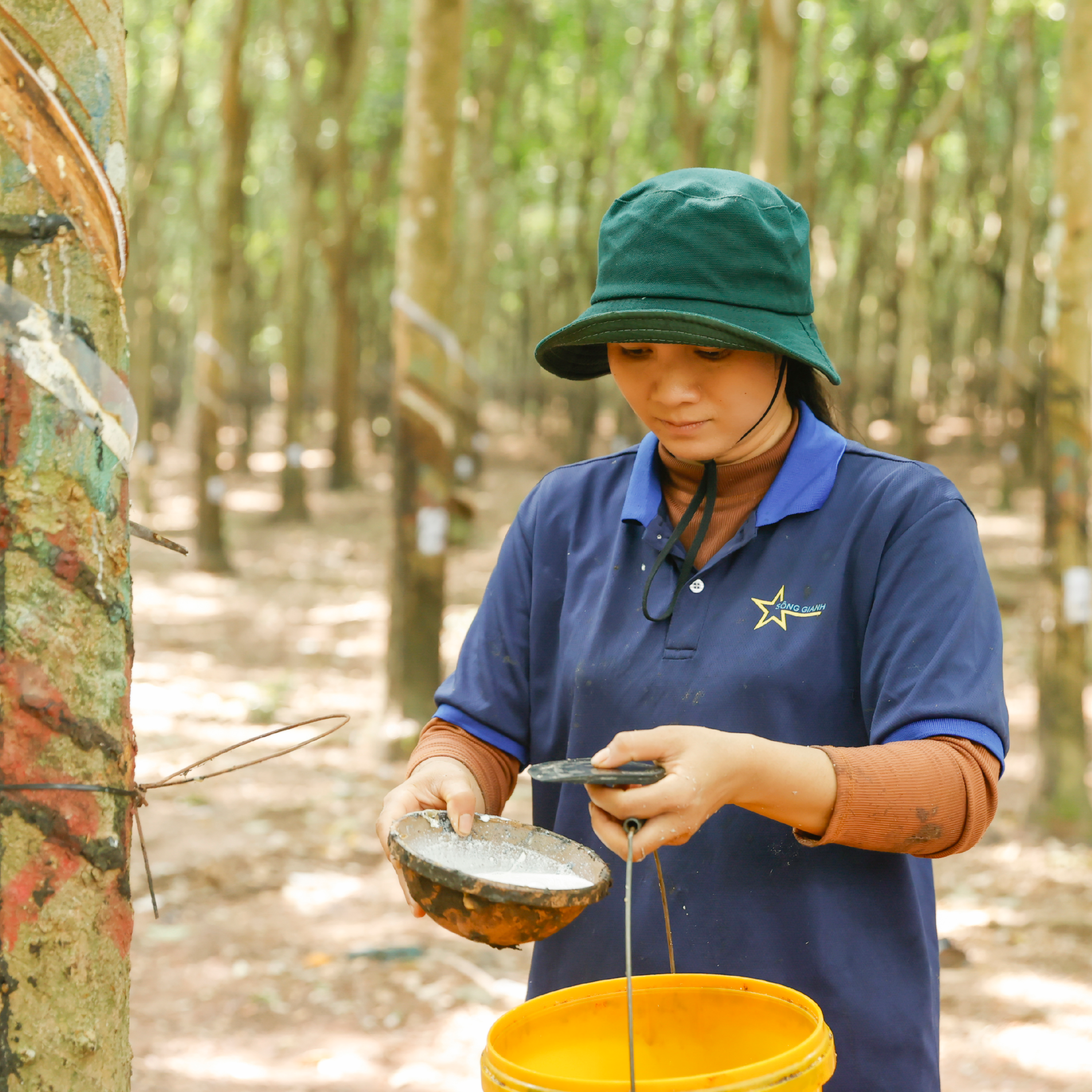
For the pilot assessment, Interface worked with leading S-LCA experts and a natural rubber supplier in Vietnam to conduct site visits and interviews with farmers, workers, and other stakeholders. Natural rubber has a complex upstream supply chain that extends beyond manufacturing. Understanding how the material is cultivated, harvested, collected, and processed can inform responsible sourcing, material transparency, and future specification decisions.
The assessment:
- Establishes a baseline for understanding the social footprint of natural rubber production
- Applies a recently codified international framework to evaluate social impact alongside environmental considerations
- Identifies strengths and opportunities for improvement within this raw material supply chain
- Supports broader learning around how social impact measurement can inform future sustainability conversations
- Encourages deeper supplier engagement, creating opportunities to support long-term climate resilience and shared learning
How S-LCA Expands the Understanding of Product Sustainability
The S-LCA findings contribute to a more complete understanding of product impact by complementing environmental data with insight into the people, communities, and upstream factors connected to material production.
The pilot assessment builds on Interface’s commitment to sustainability measurement and transparency. For over 30 years, the company has consistently explored new approaches that help customers better understand and address the environmental impact of building products. For example, Interface has pioneered the following:
- Sustainability reporting, with its first report published in 1997
- Environmental Product Declarations (EPDs), as the first US flooring company to publish a verified EPD in 2009 and the first in the industry to expand EPDs to all standard products globally in 2012
- Cradle-to-gate carbon negative carpet tiles that store more carbon than emitted during their manufacture, without offsets
- Bio-based and carbon-storing raw materials for use across carpet tile, LVT, and rubber manufacturing processes to help lower product carbon footprints
Interface is focused on its goal to become carbon negative by 2040, without offsets. By providing an early pilot example of how social impact measurement can be applied to a material supply chain, the company creates a social performance baseline that can support continued supplier engagement and more informed sourcing and sustainability decisions.
Learn More
To learn more about Interface, its portfolio of flooring solutions, and its approach to sustainability, follow the below links:
- Company and products: interface.com
- Approach to sustainability and additional resources: https://www.interface.com/US/en-US/sustainability/sustainability-overview
- Approach to product transparency: https://www.interface.com/US/en-US/sustainability/product-transparency
- Sustainability across nora® rubber portfolio: https://www.interface.com/US/en-US/resilient/rubber-and-sustainability
About Interface
Interface is a global flooring and sustainability leader dedicated to rethinking how spaces work for people and the planet. Our portfolio includes Interface® carpet tile and LVT, nora® rubber flooring, and FLOR® premium area rugs. Across every brand, we innovate in a way that combines design, performance, and sustainability—without compromise.
Trusted by architects, designers, and building professionals worldwide, we help bring bold visions to life with solutions that deliver real, measurable impact. Building on more than 30 years of sustainability progress and industry-first innovation, we remain ‘all in’ on our goal of becoming carbon negative by 2040, without the use of offsets.
Learn more about Interface (NASDAQ: TILE) and our brands at interface.com and FLOR.com. Join us on Facebook, Instagram, LinkedIn, and Pinterest.
###